
Sworn translator in Granada
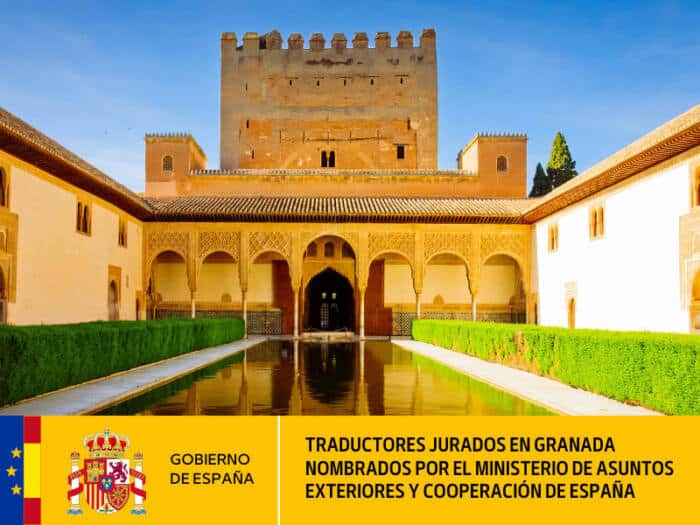
In Granada you can get a sworn translation without leaving home: send us a scan, and a sworn translator-interpreter appointed by the Spanish Ministry of Foreign Affairs (MAEC) translates and signs it, with official validity throughout Spain. We translate degrees and transcripts for the University of Granada and documents for the immigration office, the Civil Registry or the courts, with the fixed price and delivery date set in writing.
Fixed, no-obligation quote · Last updated:
Get a quote for your sworn translation
Attach your document and tell us the language and where you will submit it: the UGR, the immigration office or another authority in Granada. We will send you a fixed price and a delivery date.
"*" indicates required fields
- Translators appointed by the MAEC
- Official validity throughout Spain
- PDF with e-signature and paper copy
- Delivery date in writing
Which documents are translated in Granada, depending on your situation?
Common situations in Granada and its province. They give you a guide, but the requirements are set by the authority receiving the document: confirm them before ordering the translation.
You are coming from outside the EU to study at the University of Granada
First comes admission, then the student visa at the consulate and, once you are in Granada, the TIE. If your stay is longer than six months, you will also be asked for criminal record certificates from the countries where you have lived in the last five years.
You did your Erasmus in Granada and now want to enrol on a master’s
According to the International School for Postgraduate Studies (Escuela Internacional de Posgrado), a German, Polish or Romanian degree needs an official translation into Spanish; an Italian, French or Portuguese one does not. EU academic documents do not need legalisation.
- With translation: degrees and transcripts in German, Polish or Romanian
- Without translation: those issued in English, Italian, French or Portuguese
You live in the province and are renewing your residence or bringing your family over
The immigration office asks for translations of documents issued in another language, and some, such as criminal record certificates, are only valid for a limited time: request the certificate and its translation with the date you will submit your application in mind.
You are marrying someone from another country in Granada or applying for nationality
A wedding requires a preliminary marriage file, and nationality by residence requires documents from your country of origin. Foreign certificates must be apostilled or legalised and, if they are not in Spanish, accompanied by a sworn translation.
- Birth certificate
- Certificate of civil status
- Marriage certificate or earlier divorce
You inherit a house in the Alpujarra or on the Costa Tropical
If a British or other foreign owner dies, the notary needs the will and the foreign succession documents translated. A power of attorney signed abroad by an heir must also arrive apostilled and translated.
- Will and inheritance documents
- Death certificate
- Power of attorney granted abroad
Authorities in Granada where sworn translations are submitted
These are the authorities in the city that most often ask for translated foreign documents. Each one sets its own requirements and appointment system.
Oficina de Extranjería (immigration office) in Granada
Part of the Government Sub-Delegation in Granada and, according to the UGR residence guide, located at C/ San Agapito, 2 (on the corner of Ribera del Beiro). By appointment, it handles student stays and their extensions, residence and family reunification.
University of Granada (UGR)
The International School for Postgraduate Studies accepts translations by a sworn translator and requires them for academic documents that are not in Spanish, English, French, Italian or Portuguese. For other programmes, check with your faculty.
Registro Civil (Civil Registry) of Granada
It registers births and marriages that took place abroad, handles marriage files and takes part in nationality applications. The procedures are explained on the Junta de Andalucía website (in Spanish).
Jefatura Provincial de Tráfico (Provincial Traffic Office) in Granada
Driving licences issued outside Spain, with a DGT appointment. We translate the licence; the exchange is requested by you or your gestoría.
High Court of Justice and first-instance courts
The High Court of Justice of Andalusia, Ceuta and Melilla is based at the Real Chancillería in Granada. Foreign lawsuits, judgments and inheritance documents are submitted to it and to the province’s first-instance courts (tribunales de instancia).
Official sources consulted in October 2026: University of Granada, Government Sub-Delegation, Junta de Andalucía, DGT and Judiciary.
From the original to the counter: the right order for procedures in Granada
Many delays come from doing the steps in the wrong order. This is the order that works with a foreign document.
- In the country of origin
Apostille or legalisation of the original
It is requested where the document was issued and goes on the original. The sworn translation must include it, so it comes first.
- When asking for a quote
Complete scan and fixed price
Send every page, including the back and the apostille. Before you pay, you receive the fixed price and the delivery date in writing.
- While it is being translated
Book your appointment
The immigration office and the Traffic Office work by appointment. With the delivery date confirmed, you can book knowing when you will have the translation.
- If you are renewing your stay
Extending your student stay
The UGR guide recommends applying online in the two months before your authorisation expires. If your first stay was shorter than 180 days, you will be asked for criminal record certificates, apostilled or legalised and translated: order them well in advance.
Apostille or legalisation? What your document needs before it is translated
It depends on the country that issued the document. Both are obtained in that country, on the original, and the sworn translation must include them. The countries that apply the Convention are listed in the official status table of the Hague Conference.
Hague apostille
For countries party to the Convention of 5 October 1961.
- A single certificate from the competent authority in the country of origin.
- Countries that use it include the United Kingdom, the United States, Morocco, China and most of Latin America.
- The UGR requires it to appear on the original document.
Legalisation through diplomatic channels
For countries that do not apply the Convention.
- A chain of signatures: the relevant ministry (for degrees, the Ministry of Education), the country’s Ministry of Foreign Affairs and the Spanish consulate or embassy there.
- More steps than the apostille, so start early.
- The translation is done last and includes all the legalisation signatures.
Exceptions: Regulation (EU) 2016/1191 exempts certain EU public documents, such as birth, marriage or criminal record certificates, from the apostille. A document entirely in Spanish, such as those from Latin America, is not translated: it is only apostilled or legalised. And if yours is a Spanish document going abroad, we can arrange the Hague apostille.
How can you tell whether your translation is signed by a sworn translator?

It is signed by a sworn translator-interpreter appointed by the Spanish Ministry of Foreign Affairs, European Union and Cooperation, which makes it official throughout Spain. The University of Granada itself lists sworn translators among those who can produce official translations of academic documents.
The translator’s name and language appear on the translation, and their appointment can be checked in the MAEC’s public search tool (in Spanish).
What the translation you submit in Granada must include
Sworn translation in 39 languages
We also translate to and from Spanish in the following languages: French, Italian, German, Arabic, Chinese, Romanian, Ukrainian, Portuguese, Belarusian, Bengali, Bulgarian, Catalan, Croatian, Czech, Danish, Dutch, Estonian, Finnish, Galician, Greek, Hebrew, Hungarian, Icelandic, Japanese, Latin, Latvian, Lithuanian, Macedonian, Norwegian, Persian, Polish, Russian, Serbian, Slovak, Slovene, Swedish, Turkish and Urdu.
Do you need to travel to get a sworn translation in Granada?
No. Everything is handled remotely, with the same official status. If you would rather visit one of our offices in Malaga or Seville, let us know beforehand by phone or WhatsApp.
How we work with clients in Granada and its province
We serve clients in the same way whether they live in the city, in the metropolitan area (Armilla or Maracena, for example), on the Costa Tropical, in the Alpujarra or in inland areas such as Baza, Guadix or Loja. Your document reaches us via the form on this page, WhatsApp or email, and our reply comes the same way: a fixed, free quote, with a minimum order of €50, and the delivery date confirmed in writing. The usual turnaround is one to three weeks, depending on the language and the translator’s availability. Once you confirm and pay, the sworn translator starts work. The translation reaches you as a PDF with electronic signature, ready for an online procedure; if the authority asks for the signed original on paper, we send it to your home by courier. If you are not sure whether your document needs a translation at all, send it to us and we will tell you in our reply.
Customer service
- Monday to Friday 8:00 – 19:00
By phone, WhatsApp and email (Spanish time), for clients anywhere in Spain.
Frequently asked questions about sworn translation in Granada
I am going to study at the University of Granada. Which documents do I need to translate?
It depends on the procedure and the language. For a master’s degree, the International School for Postgraduate Studies only requires an official translation of academic documents that are not in Spanish, English, French, Italian or Portuguese, done after the apostille or legalisation. For the student visa you may also be asked for a criminal record certificate and a medical certificate. Confirm the list with your faculty or the consulate.
Do you handle the recognition (homologación) of my degree?
No. We translate the documents needed for degree recognition, such as the degree certificate itself and the transcript, but you submit the application to the relevant Ministry yourself.
My document is from Morocco. Which language is it translated from?
From the language it is written in: Moroccan documents usually come in Arabic, in French or in both, and we have sworn translators for both Arabic and French. Morocco has applied the Hague Convention since 2016: if your procedure requires legalisation, the usual route is to have the document apostilled there before it is translated.
I live in Motril or Almuñécar. Do I have to go to Granada?
No. The whole order is handled remotely from any town in the province, with the same official status, and if you need a paper copy we send it to you by courier.
Do you translate from Chinese?
Yes, from Chinese into Spanish and from Spanish into Chinese, with sworn translators appointed by the MAEC. China has applied the Hague Convention since 7 November 2023, so its documents can carry an apostille instead of consular legalisation.
Do I need the translation on paper?
Only if the receiving authority requires it. By default we deliver it as a PDF with the sworn translator’s electronic signature; if you need paper, we send it to you.
When will I have my translation?
Usually within one to three weeks, depending on the language, the translator’s availability and whether there is an apostille. Before we start, we confirm the delivery date and the fixed price in writing.
Sworn translator in other Andalusian cities
Each page covers the authorities and documents of its own province. For an overview of the service, see our page on sworn translation in Spain.