
Language interpreter for notaries, courts and business
A language interpreter translates orally, on the spot, what two people who don’t share a language are saying: at a signing before a notary, a court hearing, a medical appointment or a business meeting. ElbaTrad puts professional interpreters at your disposal — including sworn interpreters appointed by the Spanish Ministry of Foreign Affairs (MAEC) when the occasion legally requires one — in person or by video call, in the 39 languages we work with. Tell us what the occasion is, where, and in which language, and we will prepare a free quote.
Free, no-obligation quote · Last updated: August 2026

- Sworn interpreters appointed by the MAEC
- Over 400 Google reviews
- 39 languages available
- In person or by video call
Where does an ElbaTrad interpreter accompany you?
Wherever an important conversation cannot rely on gestures or improvised translations. These are the five settings where we work most:
Sworn interpreting for notaries and courts
When the occasion is official — a signing before a notary, a court hearing, a registry procedure — the law requires a sworn interpreter appointed by the MAEC, authorised to certify what is being declared. Without one, the notary or the judge can suspend the proceedings if one of the parties does not understand the language.
- Property sales, powers of attorney, inheritances, marriages and company formation
- Hearings, statements and judicial proceedings with official validity
- Appointment verifiable in the Ministry’s official register
Types of interpreting: which one do you need?
Beyond sworn interpreting, we cover every other professional mode. If you are not sure which fits your case, describe it to us and we will tell you in the quote.
Liaison interpreting
The interpreter accompanies the client and mediates between two or more people, sentence by sentence. It is the usual mode for negotiations, interviews and appointments with specialists, because it keeps the conversation natural for both sides.
Meetings · Interviews · AppointmentsSimultaneous interpreting
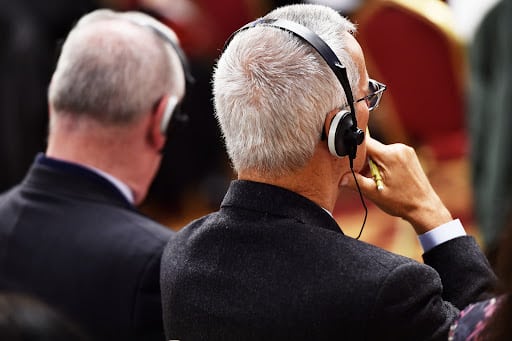
The interpreter translates in real time while the speaker talks, from a soundproof booth, with the translation delivered through headsets. It is the format of international conferences and trade fairs; in long sessions several interpreters take turns.
Conferences · Trade fairsConsecutive interpreting
The interpreter takes notes and translates once the speaker finishes each intervention. It works well for press conferences, speeches and meetings where turns can alternate without any technical equipment.
Speeches · Press conferencesWhispered interpreting
Designed for very small groups: the interpreter sits next to the client and translates into their ear, quietly and simultaneously, with no technical equipment at all. Discreet and personal.
Small meetingsEvent interpreting
Full coverage of conferences, weddings, concerts and presentations: live interpreting plus adaptation of the event materials into the audience’s language.
Weddings · Concerts · PresentationsConsecutive or simultaneous? The most common doubt
They are the two modes people confuse most when hiring. The difference lies in when the translation happens and in the equipment required:
While the speaker talks
Simultaneous
The translation reaches the audience in real time, just seconds behind. The pace of the event is never interrupted.
- Conferences, fairs and events with a large audience
- Requires a booth and headsets
- In long sessions, several interpreters take turns
When the speaker finishes
Consecutive
The interpreter translates in blocks, after each intervention. The event takes longer, but needs no installation at all.
- Speeches, press conferences and meetings
- No technical equipment
- Ideal for small groups and short occasions
How do you hire an interpreter with ElbaTrad?
No prior visits, no paperwork: you tell us your case and we assign the right interpreter — on site at the venue (we work across all of Spain, with offices in Adeje (Tenerife), Seville and Málaga) or connected by video call. Three steps:
-
Tell us about your occasion
Let us know the type of occasion, the date, the place — or whether you prefer a video call — and the languages, via the quotation form, by email or on WhatsApp.
-
Receive your free quote
We confirm the right mode, the available interpreter and a fixed price. No obligation: nothing is booked until you confirm.
-
Your interpreter, wherever you need them
On the day, the interpreter accompanies you in person or connects by video call, prepared with the terminology of your case.
Interpreter or translator? The interpreter works with the spoken word, live; the translator, with written documents. If besides the notary appointment you need to submit documents — a power of attorney, a certificate, a contract — those require their own sworn translation. We can take care of both: mention it in your quote request and we coordinate the interpreter and the document translations together.
Frequently asked questions about the interpreter service
How much does a language interpreter cost?
It depends on the mode, the duration of the occasion, the language, and whether it is in person or by video call. That is why we don’t publish a single rate: describe your case and you will receive a free, fixed quote, with no obligation, before deciding.
What is a sworn interpreter and when is one mandatory?
A sworn interpreter is appointed by the Spanish Ministry of Foreign Affairs (MAEC) and authorised to act in official proceedings, certifying what is declared, under Royal Decree 724/2020, which regulates the profession. One is mandatory in courts and notary offices: without one, the notary or the judge can suspend the proceedings if a party does not understand the language — in criminal proceedings, Directive 2010/64/EU guarantees that right to interpretation. Any appointment can be verified on the website of the Spanish Ministry of Foreign Affairs.
Can the service be provided by video call?
Yes. We offer in-person and video-call interpreting, depending on what your occasion allows. Video calls avoid travel and are common for meetings, interviews and consultations; for official proceedings, check with the institution first whether it is accepted.
Which languages are interpreters available in?
We work with 39 languages, the same as in sworn translation. Actual availability depends on the language, the date and the venue, so give us those three details when requesting your quote and we will confirm it in writing.
How far in advance should I book?
The earlier, the better: sworn interpreters for less common languages have tighter schedules. As soon as you have the date — the court listing, the notary appointment — write to us and we block the availability when you confirm the quote.
What information do you need to give me a quote?
Four details: the type of occasion (notary, court, meeting…), the date and estimated duration, the venue or whether it is by video call, and the languages to interpret between. With that we reply with mode, availability and price.